
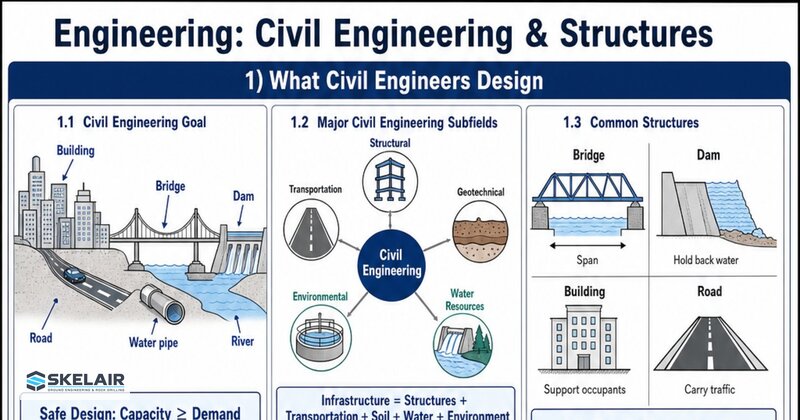
Civil engineering concerns the infrastructure people rely on, including transport routes, water systems, structures and works that manage the interaction between construction and the natural environment. Its scope extends from deciding what is needed to designing, delivering, maintaining and adapting the resulting assets. A bridge may be the visible example, but the same project also depends on ground conditions, drainage, access, inspection and long-term operation. For students, clients and construction professionals, understanding those connections is more useful than seeing the discipline only as calculations or the activity of building something large.
Civil engineering: understand the outcome before the structure
Infrastructure provides a service
A useful way to understand civil engineering is to ask what service the asset provides. A road supports movement, a drainage system manages water and a retaining structure holds ground in a defined arrangement; their value depends on how reliably they fulfil those purposes. The brief should therefore describe the need, users and constraints before settling on a particular physical solution. Otherwise, a team can produce a technically impressive structure while leaving the original problem unresolved, or commit to new construction where maintaining or adapting an existing asset would deserve consideration.
For example, a project described initially as a request for a wider road may actually concern unreliable journeys, a difficult junction or access for a particular group of users. Those are different questions with potentially different responses, so evidence about use and constraints helps define the decision. This does not mean every option will be suitable or inexpensive. It means the project should understand why its preferred solution serves the need, with alternatives and important assumptions recorded rather than allowing an early sketch to become an unquestioned requirement.
Design and delivery must fit the whole life
In civil engineering, a design is judged partly by what happens after construction. The asset needs to be operated, inspected and maintained, and it may eventually need alteration or replacement, so access and long-term responsibilities belong in the early discussion. A component that is easy to install but difficult to inspect can create a problem for the owner long after the original project team has left. The best time to identify that conflict is before the arrangement is fixed, while the design can still respond without substantial rework.
The phrase asset lifecycle captures this broader view. Initial cost matters, but the decision may also depend on durability, maintenance demand, disruption during later work and what the owner can realistically support. Compare options against the same intended service and assessment assumptions rather than assuming a low construction price necessarily produces a low overall cost. Those assumptions should be visible to the client, particularly when an apparent saving relies on maintenance that the owner has neither planned nor provided the resources to carry out.
Explore the main civil engineering disciplines
Structures and ground
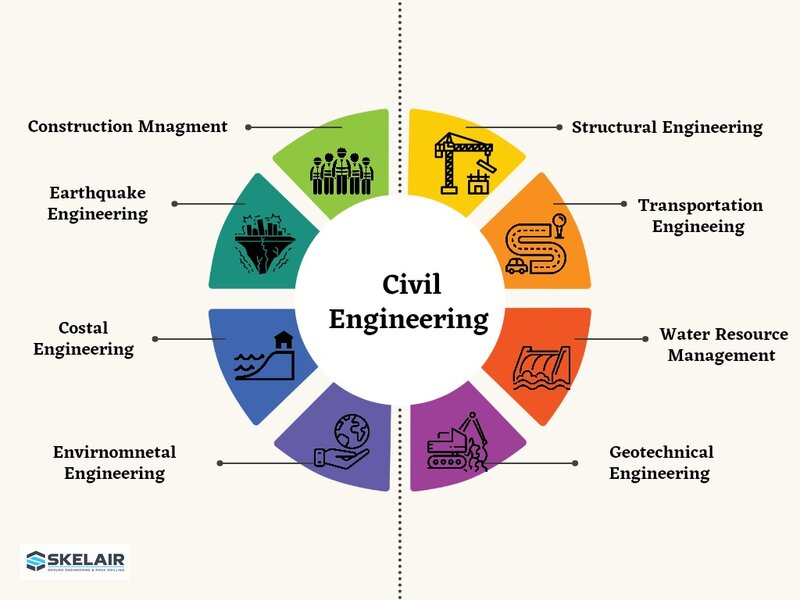
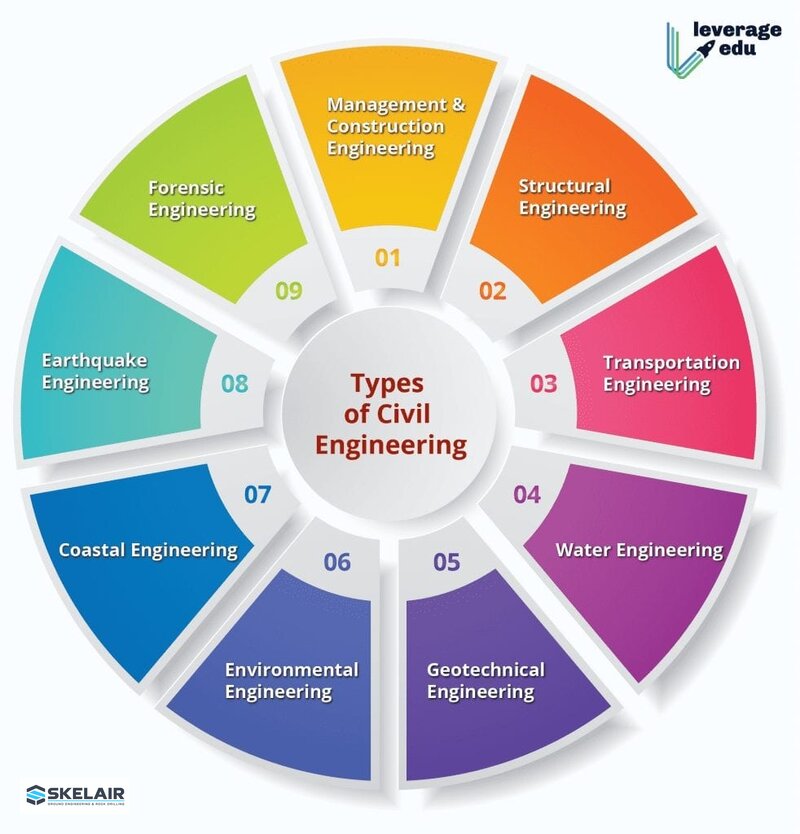
Structural work within civil engineering considers how loads are carried through an arrangement and how the structure meets its required performance. It is concerned with behaviour and serviceability as well as resistance, using the information relevant to the actual materials, geometry and construction. Bridges, buildings and retaining structures illustrate the range, but naming the structure does not define the whole appointment. A project must establish which designer addresses which elements and how information such as loading, movement requirements and temporary construction conditions is exchanged between the relevant teams.
Geotechnical work considers the engineering behaviour of soil, rock and groundwater, connecting investigation evidence with the proposed works. Its interface with structural design is important because a structure’s performance depends on how its supports interact with the ground. An investigation log is an observation at a location, while the design uses an interpretation that carries assumptions and uncertainty. The practical response is to communicate those limits and establish construction checks, not to imply that a small set of investigated points provides a complete guarantee of every condition beneath the site.
Transport, water and environmental systems

Transport civil engineering can involve networks, routes, structures and the arrangements through which people and goods move. The decisions need information about users and performance as well as physical capacity, with the operation of an existing route often constraining how changes are delivered. A technically feasible scheme may still cause substantial disruption during construction, so staging and interfaces need consideration alongside the finished layout. The design should make its assumptions about operation clear enough for the client and delivery team to understand what the proposed arrangement relies on.
Water-related work includes infrastructure concerned with supply, drainage, treatment and the management of water in the environment. Different projects require different specialist inputs, and the design must connect the intended service with the surrounding system and its operating conditions. A local improvement may affect another part of a catchment or network, so the boundary of a drawing does not necessarily contain the boundary of the problem. Environmental considerations similarly require an understanding of effects, constraints and responsibilities throughout the project’s life rather than a generic claim that any new infrastructure is automatically beneficial.
| Area of work | Typical design question | Important interface |
|---|---|---|
| Structures | How does the arrangement carry loads and meet performance requirements? | Ground, materials and construction sequence |
| Geotechnics | How will the ground behave under the proposed changes? | Investigation, structure and temporary works |
| Transport | How does the network serve users during and after the project? | Operations, access and staged delivery |
| Water | How will water be supplied, managed or treated as required? | Existing networks, environment and operation |
| Construction delivery | How can the design be built in the actual conditions? | Plant, access, people and temporary arrangements |
| Asset management | What will sustain the required service over time? | Inspection, maintenance, records and owner capability |
Follow civil engineering from brief to construction
Establish evidence and compare options
Early civil engineering work should define the problem, identify stakeholders and establish what evidence supports the available options. Existing drawings, surveys, asset condition, site information and the intended service can all affect the assessment, but their reliability and currency need consideration. A record that was accurate when an asset was built may not reflect subsequent alterations or current condition. Identify what is known, what needs verification and what uncertainty could change the decision, so further investigation has a purpose instead of becoming an unfocused collection of data.
The options appraisal should compare meaningful alternatives against agreed criteria. That may include technical feasibility, cost, maintenance, environmental effects and disruption, with the appropriate specialist assessment for each issue. Avoid presenting a precise ranking as objective if it depends on unconfirmed assumptions or subjective weightings that have not been discussed with the client. A useful appraisal explains its reasoning and limitations, allowing the project to revisit the conclusion when new evidence emerges rather than treating an early decision as a result that must never change.
Develop a coordinated design
During design, civil engineering information has to work across disciplines and appointments. Ground recommendations, structural requirements, water-management arrangements and existing services may all affect the same area, so coordination requires more than combining drawings into one file. Identify who checks interfaces and who resolves a conflict when one discipline changes its proposal. A design package should make the intended arrangement and relevant assumptions understandable to the people who must price, build and later operate it, while keeping responsibilities and review status clear.
Changes need particular care when they affect the basis of another designer’s work. A revised loading arrangement, altered level or different construction sequence can have consequences outside the apparent scope of a small drawing amendment. Establish the design coordination process and maintain a record of relevant decisions, including which parties reviewed the change. This supports a more reliable handover to construction than relying on an informal assumption that everyone receiving a revised document will independently recognise every consequence for the work they have already completed.
Include buildability and temporary stages
The delivery side of civil engineering asks how the permanent design can actually be constructed with the available access, plant, materials and site constraints. Temporary conditions may differ substantially from the completed arrangement, including during excavation, support installation and connection to existing systems. Those stages need the appropriate competent planning and design rather than an assumption that a satisfactory final structure makes every route to building it acceptable. Clarify responsibilities early enough for temporary and permanent arrangements to be coordinated before the programme commits the work to a particular sequence. Readers comparing options can find further practical guides on the Skelair homepage.
A construction sequence should also identify when the project needs information or decisions from others. A crew cannot complete a stage reliably if an unresolved approval, access agreement or design clarification is assumed to arrive without an owner or deadline. Make those dependencies visible, distinguish a confirmed arrangement from a planning assumption and record who can authorise a change. This does not eliminate uncertainty, but it gives the team a way to manage it before a late discovery becomes idle equipment, hurried improvisation or work that needs to be undone.
Manage civil engineering quality, evidence and handover
Verify requirements through the work
Quality in civil engineering means demonstrating that specified requirements are met, using evidence appropriate to the work rather than assuming that activity or expenditure proves a successful result. Inspection, testing and records should connect with acceptance criteria established by the relevant design and specification. A test result needs its identity and context, including what it represents and who reviews it. Decide how nonconforming work will be assessed and resolved before it is hidden by the next stage, because some details cannot be checked easily after construction has progressed.
The inspection and test plan can make that process practical by identifying checks, responsibilities and the points at which work should wait for a decision. Its value depends on whether it reflects the actual operation and is used by the team, not on how many generic checks it lists. When an approved change affects the specification, update the relevant checking arrangements as well as the drawing. Otherwise, the project can collect an impressive set of records that demonstrate compliance with a version of the requirement it no longer intends to build.
Deliver an asset the owner can operate
The end of civil engineering construction should leave the owner with more than a physical structure. Required records may include what was built, significant changes, relevant testing, operating information and the arrangements needed for inspection and maintenance, depending on the asset and appointment. Define those deliverables early and identify who accepts them. The moment a site is cleared is not necessarily the moment every contractual or technical obligation is complete, particularly where final documentation, monitoring or follow-up work remains outstanding.
Good handover information makes the asset understandable to people who were not present for the construction discussions. It should distinguish the original proposal from the arrangement actually installed and explain relevant limitations or continuing actions. A future maintenance team cannot safely reconstruct a changed detail from an unexplained photograph or a verbal recollection that someone else approved it. Coordinating the final records while information is available is usually more useful than trying to assemble a credible history after the specialists have moved on to other work.
Understand UK careers and professional responsibilities
Match the role to the work you enjoy
A career in civil engineering can involve design analysis, site delivery, investigation, asset management or coordination, with many roles combining several of these activities. Someone who enjoys understanding how a system behaves may prefer a different starting role from someone drawn to the daily organisation of construction. Neither description should be treated as a rigid divide: design needs practical understanding, and site roles involve technical judgment. Look at the actual work, support and learning opportunities in a vacancy rather than inferring the entire career from its job title.
Students can compare education and training routes by checking current information from relevant universities, employers and professional bodies. Entry criteria, professional-development requirements and the status of a particular programme can change, so confirm the applicable route directly rather than relying on a generic qualification promise. Ask how practical experience, technical learning and supervision are provided in the role or programme being considered. An appealing project name is useful context, but it does not establish what a new starter will learn or the responsibility they will actually be given.
Develop judgment alongside technical tools
Digital tools support civil engineering analysis, drawing, information management and coordination, but their output depends on the question, model and input information. Learning to interpret results and recognise implausible assumptions matters as much as learning where to enter data. A model can be internally consistent while representing an unsuitable simplification of the real problem. Keep the link between the tool and the physical behaviour visible, with review appropriate to the significance of the decision rather than presenting a polished image or numerical output as self-verifying evidence.
Effective communication is equally practical. An engineer should explain what a recommendation relies on, what remains uncertain and what action another person needs to take, using information suited to that person’s role. A highly technical report can still be unhelpful if the construction team cannot identify the required check or the client cannot understand a material limitation. The goal is not to remove technical detail, but to organise it so that the people relying on it can make the relevant decision without guessing which statement carries the most important condition.
Work within competence and the current framework
Professional responsibility in civil engineering includes recognising the limits of an appointment and of the individual’s competence, obtaining the appropriate specialist input and keeping significant decisions traceable. For regulatory context this guide defaults to England; current requirements elsewhere in the UK should be confirmed separately. Check the applicable official guidance and project arrangements when duties, approvals or standards affect the work. This article is general information, not professional advice, and cannot establish that a design, construction method or individual qualification meets the requirements for a particular project or role.
These responsibilities are visible in ordinary project decisions as well as exceptional situations. If site findings contradict an assumption, a material substitution lacks evidence or a planned stage has no clear responsible designer, the right response is to raise the issue through the appropriate process before relying on it. A constructive technical question can prevent a much larger problem later. Keeping the concern specific, explaining its consequence and identifying the information needed for resolution makes it easier for the relevant specialist or decision-maker to act promptly.
When choosing between roles, ask who will review your work, how questions are escalated and what responsibility you will develop as your experience grows. Those details provide a more useful picture than a broad promise of rapid progression, because sound development depends on the actual work and supervision available rather than the title printed on the vacancy.
Conclusion
Civil engineering connects public needs with infrastructure that can be designed, built, operated and maintained in the real world. Its disciplines work together through evidence, coordinated decisions and checks that connect the project brief with the asset delivered. For clients, the practical priorities are a clear outcome and well-defined responsibilities; for students and professionals, they are technical understanding, sound judgment and communication that lets others use the engineering information with confidence.
