
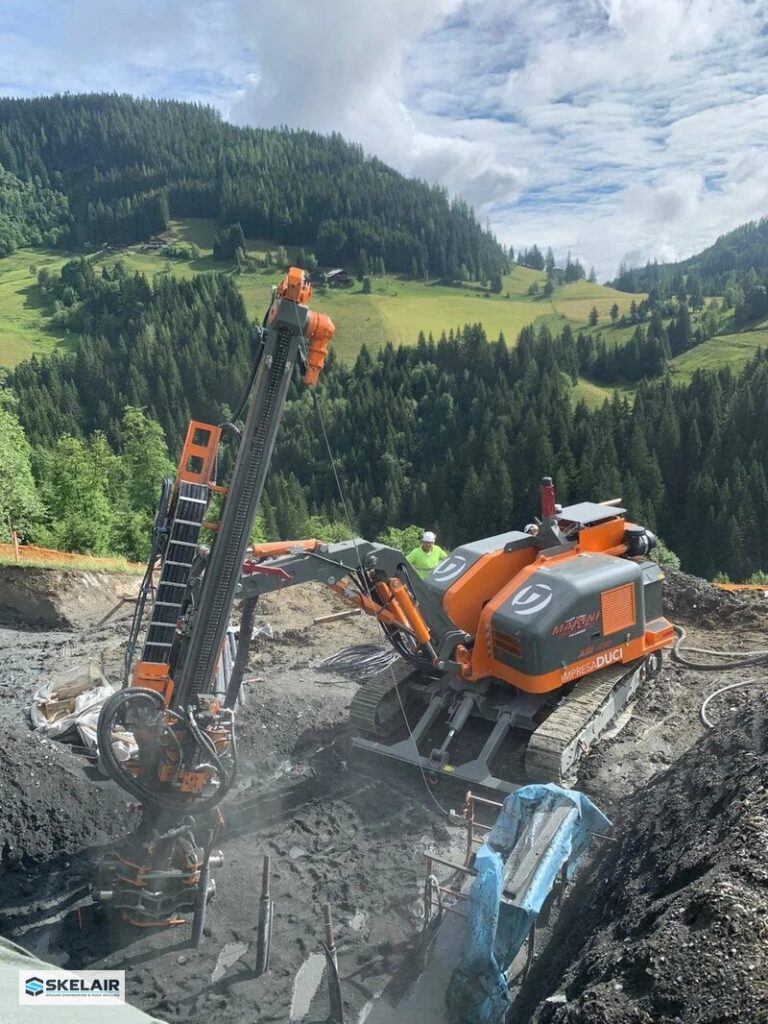
Marini drill rig can describe machines from a wide product family covering specialist foundations, civil engineering and quarry work. Marini’s official range includes compact foundation rigs, crawler machines, hydraulic and pneumatic quarry drills, rotary heads and supporting equipment. The correct choice depends on the drilling method, ground, working envelope and exact factory configuration rather than the brand name alone.
Marini drill rig range explained
Specialist foundation machines
Marini groups its foundation equipment into MR, MR-S, MR-A, MR-C and MR-P lines, with multiple models and variants within each. A Marini drill rig may therefore be configured for micropiles, anchors, soil nails, injection or piling applications, depending on its mast, drilling head, clamps and auxiliary equipment. Model codes should always be checked against the current manufacturer sheet.
The official catalogue shows both compact machines and substantially larger platforms. This breadth can help a contractor match plant to restricted access or heavier production work, but it makes casual comparisons unreliable. When assessing a Marini drill rig, ask for transport dimensions, operating weight and working envelope for the complete build, including options and tooling.
Quarry and dimensional-stone equipment
Marini also presents hydraulic and pneumatic drilling units for quarry applications, alongside wire-saw systems for marble and granite extraction. Product names include Giraffa, Baby Giraffa, Mobil Drill, Driller and other application-led machines. A quarry Marini drill rig should be selected around bench geometry, required hole orientation, rock characteristics and the site’s air or hydraulic supply.
Foundation and quarry machines should not be treated as interchangeable simply because both drill rock. Quarry production may favour repeatable positioning and rapid hole cycles, while geotechnical work can demand casing, grout, sampling or controlled inclination. The intended process defines which Marini drill rig family deserves detailed review.
Matching the rig to the task

Drilling method and tooling
Start with the bore schedule: diameter, depth, inclination, formation and required outcome. Then establish whether the work uses rotary, rotary-percussive, down-the-hole or another approved method. A Marini drill rig needs a compatible head, mast feed, pullback, flushing path and rod-handling arrangement; sufficient engine power alone does not prove suitability. It can help to compare those points with how other manufacturers position their machines, for example in the Klemm drill rig range.
Tool lengths influence both production and access. Longer rods reduce connections but require more headroom and handling space, while shorter sections add manual or mechanical handling cycles. The proposed drill string should be included when checking a Marini drill rig, because the machine and tooling operate as one system.
Access, reach and stability
Marini describes compactness, versatility and ergonomics as common priorities in its civil-engineering machines. Compact dimensions can be valuable beneath structures or on congested sites, although a machine still needs space to track, position and receive consumables. A Marini drill rig access study should show the delivery route, mast movement, tail swing and exclusion zone.
Stability depends on the actual build, mast orientation, tooling and working platform. Ground pressure summaries cannot replace a project-specific assessment near excavations, edges or slopes. Before a Marini drill rig mobilises, define platform design, drainage, inspection and what happens if the surface deteriorates.
| Selection area | Information to confirm |
|---|---|
| Application | Foundation, anchor, quarry, injection or other approved use |
| Bore requirement | Diameter, depth, inclination and formation |
| Drilling package | Mast, head, clamps, feed, pullback and flushing |
| Site envelope | Transport route, headroom, reach and set-up space |
| Support plant | Compressor, grout plant, dust control and handling equipment |
| Documentation | Exact model sheet, manual, declarations and service record |
The specification review should distinguish maximum theoretical values from the usable arrangement proposed for the job. Mast angle, head choice, rod length and fitted handling equipment can change reach, capacity and clearance simultaneously. A clear configuration schedule gives designers, operators and transport planners the same reference and prevents an option shown in general literature from being assumed to be present.
Programme planning should also allow for trial set-up and commissioning before production becomes critical. The team can then confirm hose routing, tooling compatibility, flushing returns and the operator’s sight lines under controlled conditions. A short site acceptance check is particularly useful when equipment has arrived from another market, has been reconfigured or will work with ancillary plant supplied by several organisations.
Practical site considerations

Supporting equipment and workflow
The drilling unit is only one part of the complete drilling system. Compressors, pumps, mixers, dust extraction, casing racks and spoil controls can occupy considerable space. A Marini drill rig layout should show these interfaces and keep hoses or cables away from travel routes, edges and areas where they could be damaged.
Efficient work also depends on how rods, casings and samples move through the cycle. Handling should be mechanised where reasonably practicable and planned around the selected mast. A Marini drill rig that fits physically may still be a poor choice if its crew must repeatedly work in awkward postures or enter the drilling zone.
Controls, guarding and competence
Controls and safety equipment vary between models, markets and ages. Buyers should verify the installed emergency stops, guards, interlocks, remote-control functions and warning systems rather than assume current features exist on an older machine. Safe use of a Marini drill rig requires trained operators and a task-specific plan covering rotation, percussion, pressure and movement.
Quarry and foundation sites add hazards from dust, noise, unstable faces, overhead services and buried utilities. The project must apply current UK requirements and manufacturer instructions to the actual work. This drilling safety information is general, and competent advice should guide the use of a Marini drill rig where conditions are uncertain.
Buying, hiring and maintaining the machine
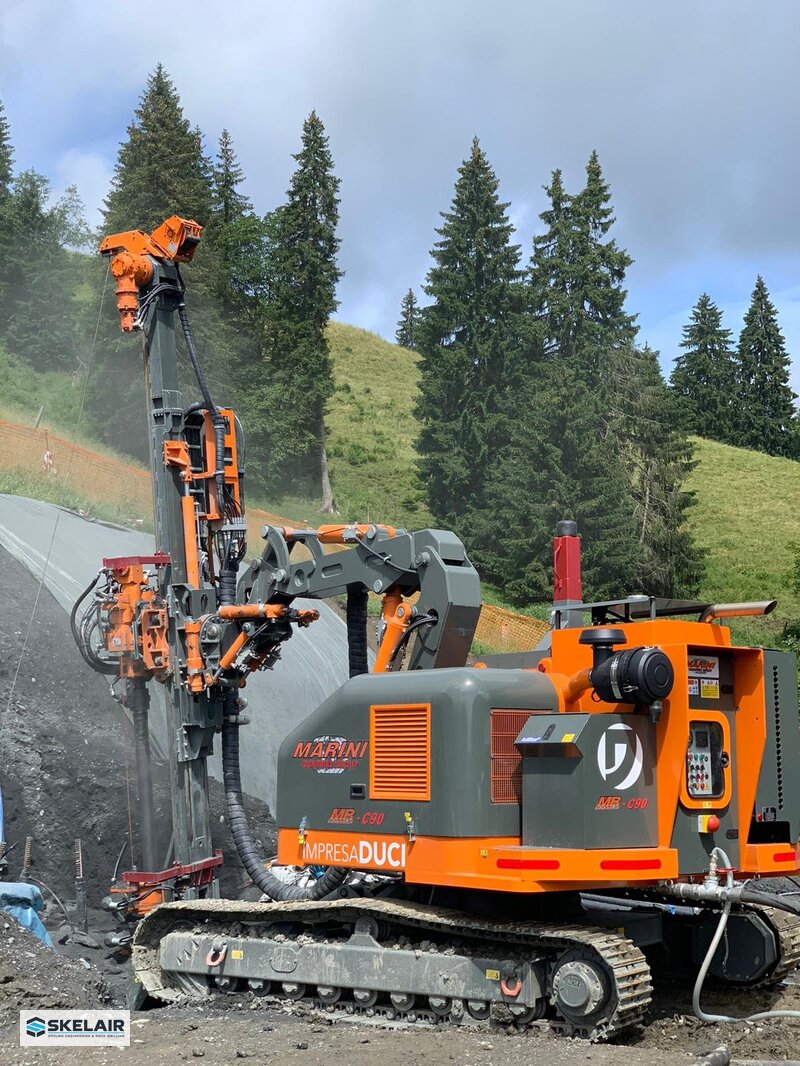
Questions for the supplier
Request the full model designation, serial number and configuration schedule. Confirm weights, dimensions, mast travel, head performance, connection sizes and all optional equipment. For a Marini drill rig, also ask which figures apply during transport and which apply in working condition, as removable components can change both.
Technical support should be assessed before mobilisation. Ask about operator familiarisation, parts availability, diagnostic help and service response in the UK. A technically suitable Marini drill rig can still create programme risk if specialist components or technicians have long lead times.
Used-equipment inspection
Used machines need more than an engine test. Inspect mast guides, feed chains or cylinders, rotary-head wear, clamps, hoses, tracks, structural repairs and control functions. Documentation for a used Marini drill rig should match the fitted equipment and identify modifications made after original manufacture.
Service history can reveal recurring faults and whether critical inspections were completed. Function testing should occur in controlled conditions with competent people, followed by checks for leakage, abnormal heat and movement. The commercial decision should include likely refurbishment and tooling costs rather than only the asking price of the Marini drill rig.
Conclusion
Marini’s official range spans specialist-foundation platforms and equipment for quarry drilling and stone extraction. Selecting a Marini drill rig means identifying the correct product family, then checking the exact mast, head, tooling and working envelope against the project. Current manufacturer documents, planned site logistics and dependable parts support provide a sounder basis for selection than model name or headline power. The final review should bring together the drilling contractor, temporary-works team and equipment supplier so that assumptions about access, platform loads, attachments and services are resolved before delivery rather than during the first shift. That shared review also clarifies responsibilities for permits, lifting and daily inspections.
