
TEI rock drill equipment includes excavator-mounted drilling attachments, limited-access rigs, hydraulic drifters and handling products. The range is aimed at work such as soil nailing, micropiles, tunnelling, mining and other rock or soil drilling. Selection starts with the bore and host machine, because the attachment, drifter, feed, hydraulics and tooling must operate as one compatible system.
TEI rock drill equipment explained
Excavator-mounted HEM products
TEI describes its Hydraulic Excavator Mount, or HEM, as its most popular drilling attachment. The system uses the excavator’s hammer circuit and combines a feed with a TEI hydraulic drifter. A TEI rock drill attachment can use the carrier’s reach and stability, but the excavator must provide the approved hydraulic flow, pressure, electrical supply and structural capacity.
The official range also includes a mid-weight MEM attachment for 12- to 15-tonne excavators and a larger HEMH model. Published MEM information includes 11 ft of drill travel, 2,500 lbf pullback and a listed attachment weight of 2,400 lb. These figures apply to that model, so another TEI rock drill should be checked against its own current brochure.
Limited-access and electric rigs
TEI also manufactures compact limited-access rigs for micropiles, foundation repair and grout holes. Its official information names TD75 and TD100 electric track drills that can accept selected patented drifters or rotary heads. An electric TEI rock drill may reduce local fumes and remove a separate hydraulic power pack, while site power and cable management still require planning.
Restricted access involves more than machine width. Headroom, mast movement, delivery route, ventilation, floor capacity and emergency arrangements can control whether the work is practicable. A TEI rock drill should be assessed in its operating configuration, with rods and handling equipment shown on the site layout.
Hydraulic drifters and feed systems

Automatic Stroke Adjustment
TEI’s hydraulic drifters use its Automatic Stroke Adjustment, or ASA, percussion system. The manufacturer states that the system reduces piston stroke and frequency when the string is not adequately engaged, helping limit dry-firing energy. On a TEI rock drill, this is a component feature rather than a substitute for correct feed pressure, competent operation and maintenance.
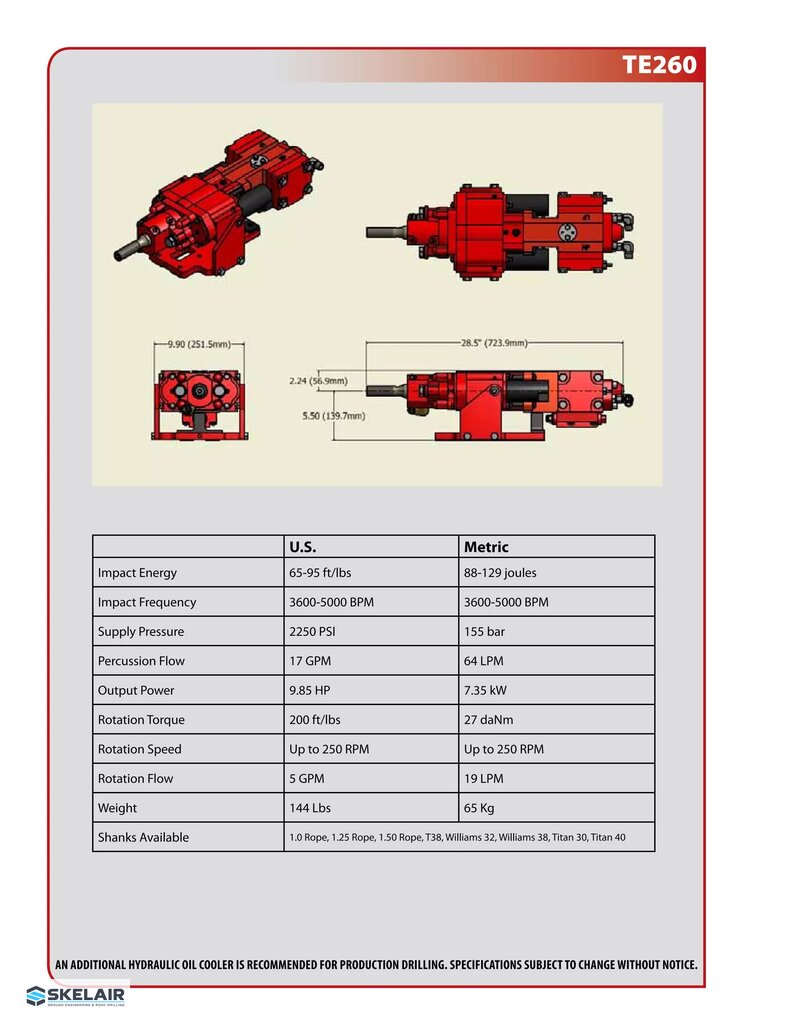
The current official page lists several drifters, including TE160, TE260, TE260HT, TE326, TE360, TE760 and TE1000. Their published output, torque and mass vary substantially. The selected TEI rock drill therefore needs a drifter matched to the bore method and carrier rather than simply the highest available power.
Flushing and tooling interfaces
The HEM page describes a built-in swivel capable of accepting air, water or grout for relevant drilling techniques, including hollow-bar installation. Each medium creates different hose, pressure and containment requirements. A TEI rock drill set-up should follow the exact drifter and swivel documentation, with fittings and hoses rated for the intended service.
Rod length, thread, bit and casing arrangements also affect the feed and handling cycle. An extended excavator attachment is offered for longer strokes, while other sites may favour shorter rods. The drill string configuration should be agreed before a TEI rock drill is mobilised so that mast travel and rod handling suit the design.
| Selection area | What to verify |
|---|---|
| Host excavator | Size, stability, hammer circuit, voltage and coupler |
| Attachment | HEM, MEM, HEMH or another current approved model |
| Drifter | Output, torque, weight and compatible tooling |
| Bore | Diameter, depth, inclination, ground and flushing medium |
| Positioning | Reach, mast orientation, headroom and exclusion zone |
| Support | Manual, training, wear parts and competent servicing |
Compatibility should be documented rather than inferred from hose connections or coupler dimensions. The attachment supplier needs the excavator model, available hydraulic flow and pressure, return-line arrangement, electrical voltage and any quick coupler details. A formal host-machine assessment can identify cooling, back-pressure or stability limitations before the equipment reaches site, when changes are easier to manage.
Commissioning should include controlled function tests, emergency-stop checks and observation of hoses through the full positioning range. The team should confirm that the operator can see the work and that assistants have a clear approach protocol. Recording these commissioning checks gives supervisors a baseline for later inspections and helps distinguish normal movement from wear or developing faults.
Tooling logistics deserve the same preparation. Rod racks, casing storage and lifting aids should remain accessible without forcing people beneath the boom or close to the mast. An agreed material-handling sequence reduces congestion and keeps the excavator’s escape and travel routes open throughout each drilling cycle.
Applications and configuration choices
Soil nails and micropiles
Excavator attachments can provide useful reach on slopes and retaining-wall projects, while limited-access rigs can work beneath structures or through constrained entrances. For soil nails or micropiles, the TEI rock drill must support the specified drilling and installation method, including casing or hollow bars where required. The designer’s assumptions about bore quality and grouting remain central.
Carrier reach should never be mistaken for unlimited safe positioning. Loads change with boom extension, mast angle and drilling reaction, while ground near a slope or excavation may be vulnerable. A TEI rock drill lift and work plan should use the excavator and attachment manufacturers’ limits and a suitable working-platform assessment.
Tunnelling, mining and confined work
TEI lists mining and tunnelling among its applications, and the low-profile drifter range includes products promoted for drifting. Confined work increases the importance of ventilation, lighting, communications and service routing. An electric TEI rock drill can address some local exhaust concerns but does not remove dust, noise, entanglement or electrical risks.
The work sequence should account for muck, water, ground support and other plant sharing the heading. A compact machine can still create a large operational exclusion zone once the mast and rods are considered. Good confined-site planning keeps people and services away from the active TEI rock drill.
Safety, controls and ownership

Positioning and remote operation
The attachment page lists options such as radio-directed control, a 360-degree positioner, quick-connect functionality and a protective cover. Availability and certification should be confirmed for the exact build and destination market. Remote control may improve the operator’s view, but a TEI rock drill still needs defined safe positions and controlled access to the drilling zone.
TEI also offers a hydraulic casing handler intended to reduce hand positioning of drill pipe and casing. The manufacturer’s claim should not be read as eliminating injury risk. A TEI rock drill operation still requires a handling plan, competent people, inspection and isolation before anyone approaches moving or pressurised parts.
Maintenance and purchasing checks
Before buying, request the serial-number-specific configuration, brochure, hydraulic requirements, operating manual and parts list. Confirm how the attachment couples to the proposed excavator and whether modifications are approved. A used TEI rock drill needs inspection for mast, drifter, hoses, coupler, structure and controls, together with its modification and service history.
Maintenance access and local support affect availability. Drifter wear, feed components and hydraulic cleanliness should be monitored at the manufacturer’s intervals. A TEI rock drill fleet plan should include correct oils, filters, seals, service tools and a route to competent technical support rather than relying on interchangeable-looking parts.
Conclusion
TEI’s range combines excavator drill attachments, limited-access machines and several hydraulic drifters for specialist drilling. The right TEI rock drill is a verified configuration matched to the bore, carrier hydraulics, working envelope and handling method. Use current official documents, plan stability and exclusion carefully, and treat options such as remote control or casing handling as parts of a wider safe system.
